Senior Seminar
By: Reece Scott
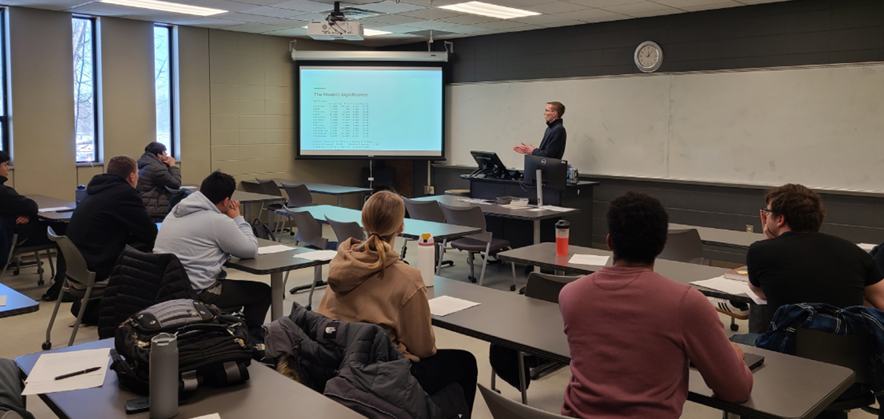
For many students in USF’s math and computer science programs, Senior Seminar is more than just another class. It is the final step before graduation and in many ways, the first step into the professional world. Senior Seminar has been part of the curriculum since the 2003–2004 academic year. The course was originally developed by Dr. Jason Douma and Dennis Roark, along with other faculty members at the time. Dr. Dou ma has been teaching college level courses since 1993 and has been at USF since 1998. Now in its 22nd year, Senior Seminar has gone through updates and changes, but its main goal has stayed the same. Senior Seminar is a yearlong capstone course where students complete an independent research project. Unlike most class es, there is no step by step set of instructions telling students exactly what to do and when to do it. Instead, students choose a major project and work through it over the course of the year. Dr. Douma explains that the real purpose of Senior Seminar is to help students shift from what he calls “student mode” to “profession al mode.” In most classes, instructors guide every assignment. In Senior Seminar, students must take ownership. They set goals, manage their time, solve problems, and adjust when things do not go as planned. This semester, students are exploring a wide variety of real-world topics. A few examples of projects include locating the most optimized E-Bike hubs, detecting phishing URLs using machine learning techniques like J48 and Naive Bayes, studying activation functions for stable gradient flow in neural networks, predicting restaurant sales through sale records, and forecasting stock price movements using multiple linear regression to name a few. These projects give students hands on experience with tools, data, and problems similar to what professionals encounter on the job. Students develop important skills in the process. Time management and personal responsibility are big ones. They also learn how to research information on their own, take on large problems that cannot be solved in just a few days, and clearly explain complex ideas in both writing and presentations. The open-ended nature of the course can be one of its biggest challenges. Sometimes students get weeks into a project only to realize it is harder than expected. Other times, the results they thought they would find simply are not there. In those moments, they have to rethink their approach and possibly change direction. That flexibility can be frustrating, but it reflects what hap pens in real professional work. The impact of Senior Seminar often goes beyond graduation. Many students have said their projects helped strengthen job or graduate school applications. One former student even built an inventory management system during Senior Seminar and later used it in his own start up business. Courses like Senior Seminar are often called “capstone” experiences because they bring together everything students have learned. According to Dr. Douma, this kind of experience helps students build confidence doing independent work in their field. For students preparing to take Senior Seminar, Dr. Douma offers simple advice “Own it.” More than any other class at USF, the course is what students make of it. Take initiative. Manage your time well. Choose a project that matters to you. Make it more than just a requirement for graduation. Senior Seminar may be challenging, but it aims to give students something valuable, confidence in their ability to work independently and step into the next chapter of life.