
“Riders to the Sea” – CST310
By: Abigael Olson
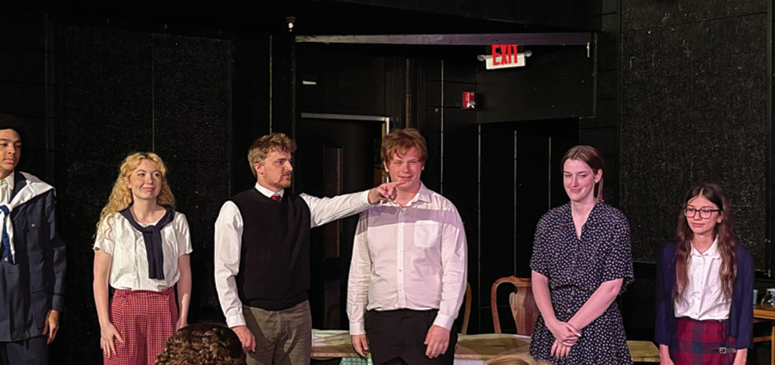
In the University of Sioux Falls’ CST310 Directing class, taught by Alecia Juelfs, fifteen different students were assigned to all create their own unique directorial concept for John Millington Synge’s Riders to the Sea. The challenge? Only two directors would be produced. Each student was given a maximum of three minutes to pitch their concept to the rest of the class, and the two most voted for directors would be given the chance to fully realize their concept, while the rest would assist as cast and crew. “I chose Riders to the Sea as the script for the final project because it checks a lot of boxes,” writes Juelfs. “It’s in the public domain, so it’s easily accessible. It’s brief but has significant emotional depth. The text is in English, but the dialect requires research to fully grasp the action. It provides enough boundaries to give directors the artistic freedom to play while having to maintain the integrity of the story.” Senior Em Mercer and Junior Ryan Presler were chosen by the class to produce their concepts. The two and their teams would be given a week and-a-half to cast, stage, and present two French scenes from the play for their finals. Presler chose to set his concept in a similar death and symbolism of the doorway. “My concept is a more traditional approach, which I hope will highlight the picture of Ireland that JM Synge creates,” said Presler. “I hope that it contrasts well with Em’s more modernized portrayal.” Presler’s set was very minimal, being made of black boxes and curtains.
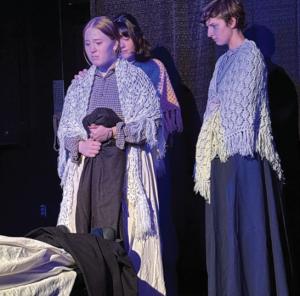 However, he chose to still dress the characters and set with historically accurate costumes and props, allowing the characters and objects they directly interact with to take the focus. “There’s a very clear divide between the inside and outside of the house in the script. The outside is where the sea is and seems to be a place where death reigns. That idea of a passageway between life and death and death encroaching on the cottage was a concept I wanted to explore in my directorial concept.” Mercer, on the other hand, relocated her version from a quiet oceanside village in 1800s Ireland to an American home in the 1940s, reeling from the effects of World War II. “I wanted my iteration of Riders to the Sea to close the distance between the tragedy of the play and the experience of the audience,” says Mercer. “I Americanized and modernized the story not only to comment on the current state of America but also to emphasize the disproportionate effect that war always has on women.” Mercer’s set featured a cozy mid-century kitchen, complete with a vintage radio, a metal tea set, and the body of her son lying on a gingham tablecloth, still in his naval uniform. She used the bright and comforting atmosphere of a stereotypical 1940s home to contrast the gloomy atmosphere of the original script, allowing the audience to feel the discrepancy between what is remembered about the era versus what life might have actually been like. Each presentation was the culmination of many months of hard work from every student in the class, not just the two di rectors. When asked about why she chose this project to end the semester, Juelfs responded, “It challenges directors to make independent choices and creatively solve problems, which is what I want students to practice while in this course.” After a long semester of directing and being directed, the class has produced fifteen capable and knowledgeable directors ready to take on their own projects.